Sunday, May 15, 2016

A520.8.2.RB_PolyarchicPrinciples_LouBeldotti


A520.8.2.RB - Polyarchic Principles


Polyarchy can work well when eight principles are in place:

Implicit Purpose                                vs.                  Explicit Objectives
Freedom to act                                   vs.                  Boundaries
Ambiguity and uncertainty                vs.                  Unambiguous feedback
People's skill and will                        vs.                  A few simple rules

Examples of each principle abound, and there is a strong overlap with principles of success identified by earlier studies such as Built to Last and Good to Great.

These principles are inter-related and support each other. It is the dynamic which exists between these principles that is important, and enables each organization to find its own unique way of applying them.

            I enjoy comparison using “versus”.  It is a lot like pros and cons.  These eight principles apply well to my military experiences.  In the Army, it was less like versus but more like “and/or”.  There was always an implicit purpose and at times, an explicit objective needed to be achieved.  There was autonomy in the Army to a point but there were always boundaries established by regulations and the Commander’s orders.  Sometimes orders were unclear and required assumptions while other times they were clear as glass but more often somewhere in between.  As mentioned earlier, autonomy sometimes existed in the Army, especially the higher rank a Soldier held.  It was that individuals skills and will to accomplish a mission.  However, rules always came into play in the form of regulations.

            Applying these principles to my current position to work more effectively seems a bit challenging but not improbable.

            In secondary educations, purpose and objectives are essentially interchangeable.  The purpose and objective is to graduate students.  Same same.  Sadly, the freedom to act is constrained by political correctness.  Fortunately for me, I am able to enjoy some form of freedom because of the uniqueness of the JROTC class.  However, public education does place boundaries regardless of what I teach.  Ok, bad example.  In secondary education, sometimes things are as clear as mud.  Encouraging clear feedback is very important in my current role.  Teachers must have clear feedback from students, administrators and parents. 

            I would like to close with not all jobs allow for these recipes for improvement.  As a public school teacher, my hands are tied more often than not. 

Reference


Obolenski, N. (2010). Complex Adaptive Leadership: Getting Chaos and Complexity to work. [Chapter 7].

Sunday, May 8, 2016

A520.7.3.RB_ImportanceOfHavingACoachandMentor_LouBeldotti


A520.7.3.RB - Importance of Having a Coach and Mentor


                My work experiences go back about 40 years.  My first paying job was when I was about twelve or thirteen and I was commissioned to paint a sign for a boardwalk skating company.  Although I did not have a coach or mentor on this job, I drew on my past coaching experiences when in junior high school art class. 

                My next job was at a boardwalk pizza place and I worked there each summer from age fifteen to age eighteen.  My boss, John, was a great coach.  I learned most of my pizza dough and pizza making skills from him.  I chuckle about this often because John is Greek.  John taught me how to work the back of the house, pizza making and boardwalk window.  John was definitely a coach to me and all of my fellow teen aged employees.  John is still in business today but his ability to coach is very limited due to MS.  What is really special about his business now is that almost all of his employees are his children and grandchildren.

                In 1983 I enlisted in the U.S. Army.  My first coach was more commonly referred to as “Drill Sergeant”.  While in training the idea of Drill Sergeant Gaylord being a coach was far fetched.  As I look back at that experience, DS Gaylord was definitely a coach.  I would not have been the Soldier that I became without the coaching of Walter Gaylord.

                Throughout the course of a 27-year Army career, I had many coaches and mentors.  As a young Soldier, most training received in these early years was in a group.  As I developed as a Soldier and leader, coaching became less and less and mentoring became more and more.  When I think back on my military career – I have been retired six years – a few heroes, real and fictional, come to mind.  One such fictitious mentor was Sergeant Morales.  According to Sergeant Daniel Nichols, the SGT Morales story goes like this, “Sergeant Morales is a fictional noncommissioned officer who is intended to represent the ideal Army NCO.  Here is his story, from the Web site of the U.S. Army Europe Sergeant Morales Club: Sergeant Morales was a squad leader for three years in an engineer battalion of a U.S. Army division.  He was the proverbial “98-pound weakling” and had not completed high school -- only the GED program.  Of Puerto Rican descent, he had only a limited command of English.  Despite his physical limitations, lack of formal education, and minority group status, he strove for and achieved the highest caliber of leadership.  Sergeant Morales began his day by coming from his home to the barracks as his squad was awakening. They participated together in PT and work details as well as unit training. Sergeant Morales pitched right in with the disliked drudgery-type details. He led by example, particularly when it meant getting his hands dirty. In his pre-Army life, Sergeant Morales had some experience as a barber. At the end of the month, when money was scarce in his squad, he arranged for his Soldiers’ hair to be cut. He kept a pocket notebook with one page for each member of his squad devoted to personal data: background, education, family, MOS, problems, and so on.  At least once a month, everyone in the squad and their spouses got together, socialized, and discussed problems at his quarters.  During his three-year tenure, no one in his squad went AWOL, which he attributed to knowing his Soldiers, keeping them informed, and watching out for their interests.  His squad consistently placed first in company Army training tests.  All of Sergeant Morales’s accomplishments were achieved despite the fact that his squad received misfits from other units for rehabilitation.  While in the division, Sergeant Morales completed high school and the equivalent of two years of college. Sergeant Morales had a lot in his favor but no special advantages.  He just worked at his job to the best of his ability.  Sergeant Morales was an exemplary leader in whom his Soldiers believed.” (Source: http://www.hqusareur.army.mil/FactFiles/FactFile_7Army_SGT MoralesStory 2007-09.pdf)

                As a Soldier in Europe, I strove to epitomize SGT Morales.  I believed just the notion of SGT Morales would make me a better leader.  Since SGT Morales was fictitious, I took the liberty of adding to his story as I coached and mentored my subordinates.  I told them tales of how SGT Morales would take his Soldiers uniforms home and wash and mend them.  He would sew on missing buttons and mend rips.  When he returned the mended and cleaned uniforms, he would teach his Soldiers to do it themselves.

                I would not be the person I am today without the mentoring and coaching of my teachers, John Koutroubis, Walter Gaylord, all of the leaders who I came in contact with over the course of my career and yes, even SGT Morales.

Reference

Nichols, D. (2009, February 27). 1st Armored Division Soldiers in Iraq compete to become members of prestigious U.S. Army Europe Sergeant Morales Club: Who is Sergeant Morales?  Retrieved on May 7, 2016 from http://www.eur.army.mil/news/2009/2009-02-27-01_Sgt_Morales.pdf


Monday, May 2, 2016

A520.6.4.RB_TeamRoles_LouBeldotti

A520.6.4.RB – Team Roles


            Depending on my occupation, my team role has varied over the years.  As a Soldier, my role also depended on my rank and position.  The greater the rank, the more involved.  When I retired and went to work for Northrop Grumman Corporation (NGC), my role was different again.  Now, as a teacher, my role has morphed yet again.

            As a Master Sergeant in the Army, my role often depended on the mission.  When I was a Command Career Counselor at U.S. Army Medical Command (MEDCOM), I was often the supervisor of a team.  I did most of the facilitating of meetings and was in-charge.  In lesser positions and rank, I was generally just a team manager.  I related well in either case and generally helped keep things on track.  I always use the common sense approach and try to be the voice of reason. 

            As a Talent Acquisition Manager at (NGC), I also facilitated meetings and managed teams.  However, there were times that I was just a team member and subject matter expert depending on the contract.  Regardless, I would always be an interactive team member.

            As a school teacher I have been relegated to just being a participant.  On the receiving end of information with very little input with the exception of the Professional Development (PD) survey that is generated to all participants.

            In a team leader position, I constantly engage my team members to accomplish the mission.  I have always expressed that there is no room for failure.  Every member has an active part.  There are no wall flowers. 

            Teamwork is paramount.  I insist that every team I have managed be cohesive and constantly communicate.  A good example of this is when I facilitated the 2009 World Wide Retention Training Seminar in Orlando, Florida.  Without a cohesive and collaborating team, it would have never happened.  I had a team of twelve individuals who performed their required functions and reported their progress at our monthly meeting in Orlando.  We would also communicate regularly via telephone and email.  Using an open line of communication was key.

Reference

Personal experiences


Sunday, April 24, 2016

A520.5.3.RB_ForrestersEmpowerment_LouBeldotti

Forrester’s Empowerment


                Empowerment.  According to Merriam-Webster, the definition of empower[ment] is to give power to (someone) or to give official authority or legal power to (someone).  (Merriam-Webster, n.d.)

                According to Russ Forrester, “Empowerment is a tantalizing notion that seems to offer organizations the promise of more focused, energetic, and creative work for employees.” (Forrester, 2000)

                My personal experiences with empowerment are mixed.  While in the Army, I had to dole out empowerment gingerly.  While employed with Northrop Grumman, I had to empower each and every one of my subordinates and as a Junior Reserve Officer Training Corps Instructor, I must be very selective of who I empower.  With this said, I believe that empowerment is very situational. 
                I was very amused with Forrester’s comment that “Empowerment is the stepchild of a grand heritage.  Its most venerable ancestor is Kurt Lewin’s notion of action research, which departed from the earlier practices by involving the subjects of change efforts in understanding and making decisions about hope-for changes.  The idea that workers might contribute to governing their own situations gained popularity with McGregor’s specification of Theory X and Theory Y beliefs about human nature and their impact on how work needs to get done.” (Forrester, 2000)

                Comparatively speaking, empowerment can either cause disaster or success.  I have been on both sides.  Empowering a young Soldier resulted in disaster and empowering seasoned Soldiers resulted in success.  I believe that maturity plays a big part in empowerment.

                Empowerment does not necessarily create leaders.  We should be very careful when we empower our employees.

References

Merriam-Webster. (n.d.). Empowerment. Retrieved on April 23, 2016 from http://www.merriam-webster.com/dictionary/empower

Forrester, R. (2000). Empowerment: Rejuvenating a potent idea. [Academy of Management Executive]. Retrieved on April 23, 2016 from http://www.jstor.org/stable/4165660?seq=1#page_scan_tab_contents


Friday, April 15, 2016

A520.4.2.RB_MotivationBeyondMoney_LouBeldotti

Motivation Beyond Money


            In the Skillsoft video, “The Three Things We Work For (Money Isn’t One of Them)”, Andy Mulholland discusses three things that employees [engineers] work for. 

1.      Interesting work.
2.      Expansion of skill sets.
3.      Recognition

(Mulholland, 2011)

            From my perspective, having interesting work is very important.  Boring and mundane work would drive me to find new employment.  According to David Whetten and Kim Cameron, “Work design is the process of matching job characteristics to workers’ skills and interests”.  (Whetten and Cameron, 2016)

            Skill training and sustainment training are essential for all employees.  I need training to perform my job effectively.  Without it, my skills would stagnate and eventually I would become bored.  I am of the opinion that most employees desire to expand their skill sets beyond initial job training.  They want to advance and without appropriate training, they cannot advance.

            Recognition is probably the most important to me.  I work even harder when I am recognized for my achievements and accomplishments.  The U.S. Army is very good at recognizing not only its Soldiers but also its civilian employees. 

            When these three motivational tools are combined, it makes for a great motivational trifecta. 
            These are great motivators but there are other that are important to me.  The following are my top three when I was in the Army:

1.      Free global travel
2.      Required physical fitness (Gyms are free in the military)
3.      Free room and board when I was a single Soldier

            The military allows its members to fly aboard their cargo and personnel aircraft if there is space available for free.  Also, all official travel is paid for by the US Government along with Per Diem, ME&I and lodging costs.  In 2009, I travelled to Europe twice, Hawaii twice and multiple states in the US on official business.  What is even more motivating is that I was able to accumulate and keep all of the frequent flyer miles and hotel loyalty points.

            Physical fitness is a requirement in the military.  High performance is incentivized by tying it to recognition and promotion.  The military gives their members a physical fitness test, twice per year and failure brings discipline and negative performance reports.  To ensure that its members stay physically fit, the military does organized physical fitness five days per week and has world class gyms on their installations which is free to the Service Members and their families.

            Single members of the military are provided free accommodations and free meals three times a day, seven days a week.  I only lived as a single Soldier for a very short time but it was a good experience.  This, in itself, saves single Service Members thousands of dollars per year.

References

Mulholland, A. (2011). Skillsoft Ireland Limited: The three things we work for (money isn’t one of them). [Video]. Retrieved on April 13, 2016 from http://library.books24x7.com.ezproxy.libproxy.db.erau.edu/toc.aspx?bookid=43753

Whetten, D. A. and Cameron, K. S. (2016). Developing Management Skills. (9th Ed). Boston: Pearson


Sunday, April 10, 2016

A520.3.4.RB_SupportiveCommunication_LouBeldotti


Supportive Communication


Below is an excerpt from the CEO of Cerner to his managers:

“We are getting less than 40 hours of work from a large number of our K.C.-based EMPLOYEES. The parking lot is sparsely used at 8:00 A.M.; likewise at 5 P.M. As managers – you either do not know what your EMPLOYEES are doing; or you do not CARE. You have created expectations on the work effort that allowed this to happen inside Cerner, creating a very unhealthy environment. In either case, you have a problem and you will fix it or I will replace you. NEVER in my career have I allowed a team that worked for me to think they had a 40-hour job. I have allowed YOU to create a culture that is permitting this. NO LONGER.”

            I probably would have taken issue to the above email if I had have received it.  It does seem like the “blame game” is being played.  However, there is an old saying in the Army, “Leaders are responsible for everything that happens or fails to happen in their organization”.  This holds true in industry also.  On more than one occasion, I have seen CEOs, CIOs, CFOs, COOs, Company Presidents and more fall to blame when the company did poorly or there was scandal involved.  More often than not, the leader resigns.

            I arrived at United States Army Medical Command (MEDCOM) located in San Antonio, Texas in Early February 2007.  On February 18, 2007, The Washington Post broke the Walter Reed Army Medical Center (WRAMC) neglect scandal.  WRAMC Commander, Major General (MG) George W. Weightman, was relieved under orders of the Secretary of Defense, by Secretary of the Army, Fran Harvey, after only being in command for six months.  Consequently, Secretary Harvey resigned less than a month later due to pressure that he had not taken action quick enough.  After MG Weightman was relieved, Lieutenant General (LTG) Kevin Kiley was named interim Commander.  Unfortunately, it was discovered that LTG Kiley had been aware of the poor care and living conditions of patients at WRAMC dating back to 2004 and he retired on March 12, 2007 less than one month after being named interim commander.  These leaders fell because they were in charge.  Mind you, other leaders much lower on the food chain were also relieved or resigned in the wake of the “scandal”.  Although I had no involvement in this, I was involved in a different capacity.  I was the Command Career Counselor of the Warrior Transition units under MEDCOM’s Command and had to travel to WRAMC to deal with the Soldiers affected.  The tension at WRAMC was so thick that you could almost cut it with a knife.  I witness absolutely no supportive communication.     
  
            Of course this situation was extremely severe and affected Wounded Warriors.  It brought about outrage from the President of the United States on down. 

            If supportive communication had have been used in the WRAMC situation, I can only speculate what could have happened.  The same outcome probably would have occurred but less feeling would have been hurt.

            In the email situation, I believe that supportive communication could be effective.  This CEO made many assumptions in his email.  Was he actually on site in Kansas City and witnessed the empty parking lot.  Although he takes ownership of the situation by stating that he allowed this to happen, he does not indicate that he plans on resigning but states that if the manager’s do not fix it, they will be replaced.  I believe this message conveyed incongruence instead of congruence.  Again, the CEO takes ownership but there is no honesty in his ownership.  He uses evaluative commentary labeling the manager’s as non-caring.  He does state the problem but definitely makes it person-oriented.  He invalidates these managers and I am sure they immediately went on the defense upon receiving the email.  His message was non-useful.  He actually did not identify the problem and offered no advice on how to fix it…just threats.  I can only assume that the CEO’s message came from out of left field and had not addressed it early making it disjunctive communication.  He did own some of the message but most of his message was disowned.  Finally, his message did not allow for supportive listening and the entire message was one-way.

Reference


Whetten, D. A. and Cameron, K.S. (2016). Developing Management Skills. (9th ed.). Boston: Pearson

Thursday, April 7, 2016

A520.3.1.RB_DecisionMakingStyles_LouBeldotti

Decision Making Styles

            Which way do I go?  How do I get there from here?  I am sure that we all have asked ourselves these questions.  It is easy and almost instantaneous to routine decisions but the complex decisions always offer a challenge.  When I was a child, I received a Magic 8 Ball one Christmas.  I would ask it questions such as, “Does Betty like me?”, “Will mom let me go skating?”, “Will I be a doctor when I grow up?”.  This took away the decision making process for me. 

            According to Wikipedia, the Magic 8-Ball has a twenty-sided die that provides twenty possible answers to the question asked.  The twenty answers are:  It is certain; It is decidedly so; Without a doubt, yes; Definitely; You may rely on it; As I see it, yes; Most likely; Outlook good; Yes; Signs point to yes; Reply hazy try again; Ask again later; Better not tell you now; Cannot predict now; Concentrate and ask again; Don’t count on it; My reply is no; My sources say no; Outlook not so good; Very doubtful. (Wikipedia, 2016)

            Well, I never dated Betty, I did get to go skating but I never became a doctor.  So much for the Magic 8-Ball.

            In the blog, I will answer the following questions:

1.      What are a few words that describe your decision-making style?
2.      What are the opposites of the words you chose?
3.      Could you see any benefits to making decision using an approach that is based on either the opposites or somewhere in-between and what outcomes would you expect to see?

            Now that I am a grown man, my decision making style has changed from trusting the Magic 8-Ball to more concise and thoughtful.  I don’t use chicken bones or tea leaves.  I do ponder on the more complex decisions.  I often use tools like brain storming, pros and cons and mind mapping. 

            The opposite words would be lengthy, vacant and ignore.

            In some situations I could see the opposite word, lengthy as beneficial.  Long pondering is sometimes required to make the correct decision.  I cannot not see the opposite words, vacant and ignore as a viable part of the decision making process.

References
Haddock, R. (2004). Routine and complex decision-making. [Infobase: Films on demand]. Retrieved on April 7, 2016 from http://fod.infobase.com.ezproxy.libproxy.db.erau.edu/p_ViewPlaylist.aspx?AssignmentID=7A2UTV

Wikipedia. (February 22, 2016).  Magic 8-Ball. Retrieved on April 7, 2016 from https://en.wikipedia.org/wiki/Magic_8-Ball


Monday, April 4, 2016

Conflict Resolution


Rock, paper, scissors
                The game, rock-paper-scissors is probably not the best way of solving conflict.  I guess you could throw the rock, stab with the scissors or give someone a paper cut but nothing good would come of that.

                This blog is about conflict resolution.  The assignment asks me to answer the following questions:

  • What was the conflict?
  • What role did you play?
  • Who were the other participants in the negotiation?
  • What was the result?
Can you see any room for improvement to how the conflict was handled?

                I have encountered many conflicts during my 27-year Army career.  I’m not just speaking of armed conflict but also of arguments and squabbles.  One such squabble comes to mind.

                I was a squad leader in unit at Fort Lewis, WA in the mid-1980s.  Two of my Soldiers were in a heated argument about guard duty.  Both wanted to be on first shift and were about to go to blows over the whole thing just as I stepped in.

                Being a Noncommissioned Officer, they had to follow my direction.  However, I took some time and sat the two Soldiers down.  I asked each one why they wanted the first shift of guard duty.  The first individual informed me that he had a date and needed the first shift so that he could be on time for his date.  The second Soldier stated that he needed first shift so that he could go fishing.  I asked the two which situation seemed the most important?  Of course, they both stated that their individual situation was most important.  So, I had them each right down the PROs and CONs of their particular situation.  Once they had completed this task, we compared and contracted their answers.  The Soldier that wanted to go fishing came to the conclusion that the Soldier who wanted to go on a date had the more important situation.  After all, he could go fishing anytime.  However, there was a caveat that came with their decision.  The Soldier who was giving up on first shift required that the other Soldier pull his next duty when it occurred.  They both agreed to this and the conflict was over.


                I believe I handled the situation quite well as a young Soldier.  Looking back, I may have done a few things differently but would have used the same tools at my disposal.

Sunday, April 3, 2016

A520.2.5.RB_TimeManagement_LouBeldotti

Time Management


            Doesn’t seem as if we are always in a race with the clock?  There are so many phrases involving time and our embattlement with the clock.  Sometimes it is good and sometimes bad.  “How much time do I have?”, “Time!”, “Time to go.”, “Time for a change.”, “What time is this over?”, “Can I have more time?”, “Timing is everything.”, “Is my time up?”, “Time is my enemy.” and much more.  We are always looking at clocks and our watches.  We are always asking people about the time.  Heck, there are even songs written about time… “Time is on my side”, “Time after Time”, “Time”, “Time passages”.  It seems that all game shows have some time element and there have even been game shows dedicated to time like “Beat the Clock” and “Time Machine”.  We are simply always dealing with time.  The question, however, is how do we deal with it?

            I personally believe I am pretty good with time management when is comes to my work life.  However, time seems to get away from my when it comes to my home life and continued education.

            In this blog I will attempt to answer the four questions asked of me in my current ERAU assignment, if I have time…pun intended.

1.      Assess your time management skills.  I believe I have great time management skills while I am at work.  I am never let for my job and, as a matter of fact, I am usually about 45 minutes early every day.  I am able to complete each class that I teach on time and fulfill all of my class requirements on time.  However, in the midst of it all, I still have a hard time managing all of things that I need to do at home and my studies at ERAU.  I feel that it is partly because of the hours I devote to my occupation and my desire to relax while at home.

2.      Evaluate how these skills have increased your locus of control.  I believe that I have control of all things that affect me.  However, once I get home, I somehow let time get away from me.  Maybe it’s because as soon as I shed my uniform my focus goes elsewhere.  I usually start cooking when I get home and also care for three dogs.  My wife doesn’t finish working until 5:00p and I do my best to have dinner ready by then.  If I am not doing something with my Cadets on the weekend, I do not set an alarm.  On weekends I usually cook breakfast and then hit the books.  If I have spare time at work, I do some school work.  I think that it is just life.  Work, home, cars, wife, bills, dogs and everything else that goes along with it.  Yes, I have the time management skills and can affect things around me but, at the end of the day, I just live my life.
 
3.      Identify three new areas in which improved time management skills would reduce stress.  One area is returning to school.  I need to work on completing my studies in a timelier manner.  When Sunday rolls around I am always at crunch time.  I need to work on getting all of my home chores in a timelier manner.  I have multiple projects in some state of completeness that I just have to finish.  I am always telling my wife that I get something done during Christmas break, during spring break, on three-day weekends and finally during summer break.  Well, just about every break has passed and I am still behind.  Finally, tax day is swiftly upon us.  I have not even started them.  Geez!  I feel that Sunday the 17th will be here before I know it and it will be crunch time.  All of these things cause me stress and they must be addressed.

4.      Add an action plan to integrate these to your daily routine.  I need lists!  List of things to do and when they need to be completed.  I need to set timers on my cell phone and tablet.  I need reminders!  My plan, moving forward is to do just this.  I plan on devoting at least two hours of every day to my studies, gathering all of my tax documents immediately and completing my taxes this coming weekend and devoting one hour per day to my home chores starting immediately. 


Wish me luck!

Sunday, March 27, 2016

A520.1.4.RB.LouBeldotti


Self-Awareness

According to David Whetten and Kim Cameron's text, there are five core aspects of self-awareness and managerial implications,  They are:

  • Core Self-Evaluation - Identifies underlying personality attributes.
  • Values - Identifies personal standards and moral judgments. 
  • Learning Style - Identifies information acquisition and evaluation.
  • Attitudes Toward Change - Identifies adaptability and responsibility.
  • Emotional Intelligence - Identifies emotional awareness and control.
This leads to:

  • Self-understanding and self-management.
  • Managerial effectiveness, job satisfaction, and job performance.
  • Understanding differences in others.
(Whetten and Cameron, 2016)

This is my third MSLD course in my degree plan.  Although I have already held many leadership positions in my 52 years of life, my 27-year Army career, my short-lived private sector employment and my five years of school teaching, I have truly grown in my processes since last November during this educational experience.

I have been able to evaluate my personality attributes in a whole new way.  My values and learning styles are already well established but my attitude toward change has greatly changed.  I am very hard headed and set in my ways but Gerald Nosich and Dr, Gary Yukl have helped me to re-assess my whole thought process.  (Nosich, 2012) (Yukl, 2013).  Finally, my emotional awareness and control are pretty much set in stone.

I do believe I have grown during my studies.  I little in some aspects and leaps and bounds in others.

I am sure that upon my completion in this course of study, I will make great changes in my leadership style.

References

Whetten, D. A. and Cameron, K. S. (2016). Developing Management Skills. (9th Ed). Boston: Pearson

Nosich, G. M. (2012).  Learning To Think Things Through: A Guide To Critical Thinking Across The Curriculum. (4th Ed). Boston: Pearson

Yukl, G. (2013). Leadership In Organizations. (8th Ed). Boston: Pearson


Monday, March 7, 2016

A511.8.3.RB_LouBeldotti_Gender


GENDER


            In Yukl’s text, Dr. Yukl states, “Gender egalitarianism is the extent to which men and women receive equal treatment, and both masculine and feminine attributes are considered important and desirable.  In cultures with high gender egalitarianism, there is less differentiation of sex roles and most jobs are not segregated by gender.  Women have more equal opportunity to be selected for important leadership positions, although access is still greater for public sector positions than in business corporations.  In the absence of strongly differentiated gender-role expectations, men and women leaders are limited in their behavior, and there is less bias in how their behavior is evaluated by subordinates and by bosses.” (Yukl, 2013)

            In my experiences, I have witnessed this while living in Europe.  I saw woman in public office and positions of authority such as police and military.  Conversely, I have witnessed less of this in the United States, especially in the military.  For years, women have not officially served in combat roles and were not allowed access into “male only” jobs.  However, this is changing.  According to the New York Times article by Matthew Rosenberg and Dave Philipps, “In a historic transformation of the American military, Defense Secretary Ashton B. Carter said on Thursday that the Pentagon would open all combat jobs to women.

            “There will be no exceptions,” Mr. Carter said at a news conference. He added, “They’ll be allowed to drive tanks, fire mortars and lead infantry soldiers into combat. They’ll be able to serve as Army Rangers and Green Berets, Navy SEALs, Marine Corps infantry, Air Force parajumpers and everything else that was previously open only to men.”

            The groundbreaking decision overturns a longstanding rule that had restricted women from combat roles, even though women have often found themselves in combat in Iraq and Afghanistan over the past 14 years.” (Rosenberg and Philipps, 2015).

            During her April 2, 2010 Harvard Business Review interview, Rosabeth Moss Kanter discusses how there is still a pay gap between men and women.  She believes that it has taken a long time to get women into top positions in certain occupations.  It takes dedication and commitment to hold these top positions.  People are juggling lots of other responsibilities and they align themselves to be placed in these positions but Ms. Kanter believes that companies still discriminate based on gender.  Moreover, she believes that women are not equally compensates although they hold the same positions as their male counterparts.  She informs the viewer that women’s median compensation moves very slowly and has actually slowed even more over the last ten years.  She indicates many reasons but what it boils down to is sex-based discrimination. (Kanter, 2010).

            According to Yukl, “Widespread discrimination is clearly evident in the low number of women who hold important, high-level leadership positions in most types of organizations.  The strong tendency to favor men over women in filling high-level leadership positions has been referred to as the ‘glass ceiling.’  Only a small number of nations have female a head of state (e.g., prime minister, president), and the number of women in top executive positions in large business organizations is also very small, although it has been increasing in recent years.  In the complete absence of sex-based discrimination, the number of women in chief executive position in business and government should be close to 50 percent. (Yukl, 2013).


References
Yukl, G. (2013). Leadership in Organizations. (8th ed). Pearson: Boston

Rosenberg, M. and Philipps, D. (December 3, 2015). All Combat Roles Now Open To Women, Defense Secretary Says. Retrieved on March 6, 2016 from http://www.nytimes.com/2015/12/04/us/politics/combat-military-women-ash-carter.html?_r=0

Kanter, R. M. (April 2, 2010). Harvard Business Review: Woman, Ambition and (Still) the Pay Gap. Retrieved on March 6, 2016 from https://www.youtube.com/watch?v=EhquUOlBuOY&feature=youtu.be&t=5s


Sunday, February 28, 2016

A511.7.3.RB_LouBeldotti_Self-Awareness

Self-Awareness

            Who am I?!  There has been more than one morning that I have looked at myself in the mirror and pondered my reflection.  Self-awareness is not always the man or women in the mirror.  More often it is knowing who we are as a leader.  Our traits, our behaviors, our beliefs, our behaviors.  Especially how we behave when dealing with our subordinates. 
            Serving in the Army, leadership has a strange dynamic.  Most Soldiers spend the first three to five years as an “underling”…a Private through Specialist.  These are the ones who do 90% of the work.  Then Suddenly a Soldier becomes a leader when he or she gets promoted to the Nonommissioned Officer (NCO) ranks of Corporal or Sergeant.  The dynamic can be compared to a person winning the lottery.  Suddenly this person is on top of the world.  It is like the proverbial flipping a switch.  They have not grown into their position and sort of “lose their minds”.  They alienate former friends, aggravate seniors and are filled with self-puffery. 
            In Rob Goffee and Gareth Jones’ paper, Getting personal on the topic of leadership: Authentic self-expression works for those at the top, the two state, “What characterizes effective leaders is a sense of what works for them with others.  They know and show enough of themselves to win over their followers.”  These two also go on to discuss the leadership traits of Bill Gates, John Harvey-Jones, Akio Morita, Darwin E. Smith and Ken Livingstone. (Goffee, R. And Jones, G., 2006)
            Regardless of the personality or personal traits of a leader…geeky, long hair and neck ties, boundless energy, modesty, or simple and plain living, a leader must know who he or she is. 
            I was one of those Soldiers who thought the world was my oyster when I was promoted into the world of the NCO ranks.  I alienated my fellow Soldiers and aggravated my senior leaders.  Honestly, it was just a phase.  I got beyond it.  After reality sank in, I began looking at myself as a leader.  Who was I as a leader?  How was I as a leader?  Was I even a leader or did I just wear the ranks of a leader?  It took time but I eventually understood who I was as a leader.  Only then, was I able to lead.

Reference
Goffee, R. and Jones, G. (2006). Getting personal on the topic of leadership. [Human Resource Management International Digest].  Vol 14. Number 4.  Pages 32-34. 


Sunday, February 21, 2016

A511.6.3.RB_LouBeldotti_Meaning

Meaning

http://beldottilou.blogspot.com/

            I have been exposed to many leaders.  I have met H. Norman Schwarzkopf…he was a big man in person and a big man as a leader, I have met Franky Fontaine…he led with his humor, and I have met Lee Debois…he led with his vision.  I have sat through many leadership seminars and watched Zig Ziglar stand on the edge of a stage, teetering on the brink of falling off, and watched a more demure Brian Tracy speak of leadership from a chair.  I watched my Grandfather lead with an old world iron fist and I experienced the quite spoken, General Eric Schoomaker, MD, Ph.D., lead his unit and Army with gentle prodding.  These men led from the front.  They led with their style and expected results.  Some led gently while others led with force.

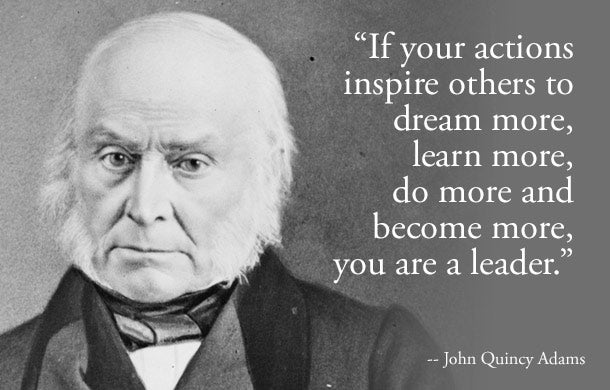
            Just like John Quincy Adams, he led but led with the overshadowing of his father.  Most of these leaders that I have mentioned led under someone’s shadow.  General Schwarzkopf was overshadowed by his father who was also a general, Franky Fontaine laid under the shadow of the Vaudevillians who came before him, Lee Debois was self-made as was Zig Ziglar, and Brian Tracy led by trial and error.  My grandfather lead by his upbringing…his father immigrated to the US in 1910 and brought old world thinking and my former boss, LTG Schoomaker was overshadowed by his brother General Peter Schoomaker who had been the Chairman of the Joint Chiefs.

            For the most part, these were big shoes to fill.  Giant men to follow.  A reputation to live up to.  I, too, know this feeling.  As I grew into a leadership role, I was always replacing a leader.

            Regardless, these leaders and I have always been faced with helping our follows find meaning for what they do.

            Dave and Wendy Ulrich ask the questions and provide the answer to engaging our followers: “So how can leaders more systematically help employees find meaning at work? We culled research from diverse fields of thought and identified seven drivers of meaning that leaders can leverage in the following ways:

  1. Help employees identify and creatively use the strengths, traits, and values (like integrity, leadership, love of learning, kindness, etc.) with which they most identify. Two useful tools for doing so are the Buckingham Strengthsfinder or the VIA Survey of Character Strengths.
  2. Match the purposes (insight, achievement, connection, or empowerment) that motivate employees to the jobs they do. For example, ask employees to spend 20 minutes writing about what work would look like if all their aspirations came true. Then help them build individual development plans to pursue those dreams.
  3. Foster friendships and key relationship-building skills — like making and receiving bids and apologizing effectively — to create high-performing, high-relating teams.
  4. Promote positive work environments through attention to characteristics like humility, selflessness, order, and openness. Survey employees on how well your organization exemplifies these crucial qualities; then develop a plan to improve where the results indicate the company falls short.
  5. Help people identify and work at the types of challenges that line up with their personal experience of engagement or flow.
  6. Build in time for both individual and corporate-level self-reflection to help people discover lessons from setbacks and develop the resilience to get in front of the pace of change.
  7. Encourage civility and delight from little things that personalize and civilize the world of work (e.g. time to chat, friendly competitions, pictures, and humor). Nokia, for instance, distributed thousands of plastic bracelets that employees wore to remind them not to complain for 21 days.
            To paraphrase Nietzsche, “He who has a ‘why’ to work can bear with almost any how.” To get the most from their employees, leaders should do all they can to make this “why” clear.
            We must give our followers the “why” and the motivation and not just the how.

Reference

Ulrich, D. and Ulrich, W. (June 2, 2010). Getting Beyond Engagement to Creating Meaning at Work. Retrieved on February 21, 2016 from https://hbr.org/2010/06/getting-beyond-engagement-to-c