Meaning
http://beldottilou.blogspot.com/
http://beldottilou.blogspot.com/
I
have been exposed to many leaders. I
have met H. Norman Schwarzkopf…he was a big man in person and a big man as a
leader, I have met Franky Fontaine…he led with his humor, and I have met Lee
Debois…he led with his vision. I have
sat through many leadership seminars and watched Zig Ziglar stand on the edge
of a stage, teetering on the brink of falling off, and watched a more demure
Brian Tracy speak of leadership from a chair.
I watched my Grandfather lead with an old world iron fist and I
experienced the quite spoken, General Eric Schoomaker, MD, Ph.D., lead his unit
and Army with gentle prodding. These men
led from the front. They led with their
style and expected results. Some led
gently while others led with force.
Just
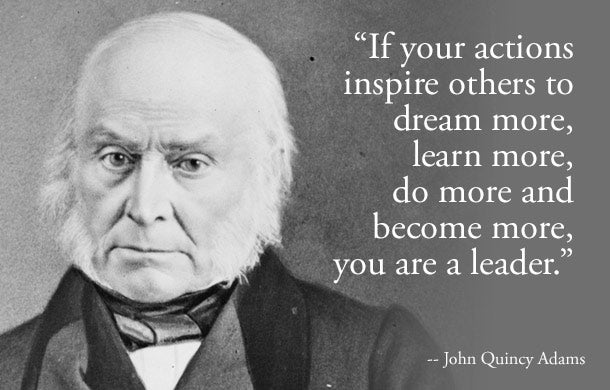
like John Quincy Adams, he led but led with the overshadowing of his
father. Most of these leaders that I
have mentioned led under someone’s shadow.
General Schwarzkopf was overshadowed by his father who was also a
general, Franky Fontaine laid under the shadow of the Vaudevillians who came
before him, Lee Debois was self-made as was Zig Ziglar, and Brian Tracy led by trial
and error. My grandfather lead by his
upbringing…his father immigrated to the US in 1910 and brought old world
thinking and my former boss, LTG Schoomaker was overshadowed by his brother General
Peter Schoomaker who had been the Chairman of the Joint Chiefs.
For
the most part, these were big shoes to fill.
Giant men to follow. A reputation
to live up to. I, too, know this
feeling. As I grew into a leadership
role, I was always replacing a leader.
Regardless,
these leaders and I have always been faced with helping our follows find
meaning for what they do.
Dave
and Wendy Ulrich ask the questions and provide the answer to engaging our
followers: “So how can
leaders more systematically help employees find meaning at work? We culled
research from diverse fields of thought and identified seven drivers of meaning
that leaders can leverage in the following ways:
- Help employees identify and creatively use the strengths, traits, and values (like integrity, leadership, love of learning, kindness, etc.) with which they most identify. Two useful tools for doing so are the Buckingham Strengthsfinder or the VIA Survey of Character Strengths.
- Match the purposes (insight, achievement, connection,
or empowerment) that motivate employees to the jobs they do. For example,
ask employees to spend 20 minutes writing about what work would look like
if all their aspirations came true. Then help them build individual
development plans to pursue those dreams.
- Foster friendships and key relationship-building skills
— like making and receiving bids and apologizing effectively — to create
high-performing, high-relating teams.
- Promote positive work environments through attention to
characteristics like humility, selflessness, order, and openness. Survey
employees on how well your organization exemplifies these crucial
qualities; then develop a plan to improve where the results indicate the
company falls short.
- Help people identify and work at the types of
challenges that line up with their personal experience of engagement or
flow.
- Build in time for both individual and corporate-level
self-reflection to help people discover lessons from setbacks and develop
the resilience to get in front of the pace of change.
- Encourage civility and delight from little things that
personalize and civilize the world of work (e.g. time to chat, friendly
competitions, pictures, and humor). Nokia, for instance, distributed
thousands of plastic bracelets that employees wore to remind them not to
complain for 21 days.
To paraphrase Nietzsche, “He who has
a ‘why’ to work can bear with almost any how.” To get the most from their
employees, leaders should do all they can to make this “why” clear.
We must give our followers the “why”
and the motivation and not just the how.
Reference
Ulrich, D. and Ulrich, W. (June 2, 2010). Getting Beyond Engagement to Creating Meaning at Work. Retrieved on February 21, 2016 from https://hbr.org/2010/06/getting-beyond-engagement-to-c

No comments:
Post a Comment