Sunday, February 28, 2016

A511.7.3.RB_LouBeldotti_Self-Awareness

Self-Awareness

            Who am I?!  There has been more than one morning that I have looked at myself in the mirror and pondered my reflection.  Self-awareness is not always the man or women in the mirror.  More often it is knowing who we are as a leader.  Our traits, our behaviors, our beliefs, our behaviors.  Especially how we behave when dealing with our subordinates. 
            Serving in the Army, leadership has a strange dynamic.  Most Soldiers spend the first three to five years as an “underling”…a Private through Specialist.  These are the ones who do 90% of the work.  Then Suddenly a Soldier becomes a leader when he or she gets promoted to the Nonommissioned Officer (NCO) ranks of Corporal or Sergeant.  The dynamic can be compared to a person winning the lottery.  Suddenly this person is on top of the world.  It is like the proverbial flipping a switch.  They have not grown into their position and sort of “lose their minds”.  They alienate former friends, aggravate seniors and are filled with self-puffery. 
            In Rob Goffee and Gareth Jones’ paper, Getting personal on the topic of leadership: Authentic self-expression works for those at the top, the two state, “What characterizes effective leaders is a sense of what works for them with others.  They know and show enough of themselves to win over their followers.”  These two also go on to discuss the leadership traits of Bill Gates, John Harvey-Jones, Akio Morita, Darwin E. Smith and Ken Livingstone. (Goffee, R. And Jones, G., 2006)
            Regardless of the personality or personal traits of a leader…geeky, long hair and neck ties, boundless energy, modesty, or simple and plain living, a leader must know who he or she is. 
            I was one of those Soldiers who thought the world was my oyster when I was promoted into the world of the NCO ranks.  I alienated my fellow Soldiers and aggravated my senior leaders.  Honestly, it was just a phase.  I got beyond it.  After reality sank in, I began looking at myself as a leader.  Who was I as a leader?  How was I as a leader?  Was I even a leader or did I just wear the ranks of a leader?  It took time but I eventually understood who I was as a leader.  Only then, was I able to lead.

Reference
Goffee, R. and Jones, G. (2006). Getting personal on the topic of leadership. [Human Resource Management International Digest].  Vol 14. Number 4.  Pages 32-34. 


Sunday, February 21, 2016

A511.6.3.RB_LouBeldotti_Meaning

Meaning

http://beldottilou.blogspot.com/

            I have been exposed to many leaders.  I have met H. Norman Schwarzkopf…he was a big man in person and a big man as a leader, I have met Franky Fontaine…he led with his humor, and I have met Lee Debois…he led with his vision.  I have sat through many leadership seminars and watched Zig Ziglar stand on the edge of a stage, teetering on the brink of falling off, and watched a more demure Brian Tracy speak of leadership from a chair.  I watched my Grandfather lead with an old world iron fist and I experienced the quite spoken, General Eric Schoomaker, MD, Ph.D., lead his unit and Army with gentle prodding.  These men led from the front.  They led with their style and expected results.  Some led gently while others led with force.

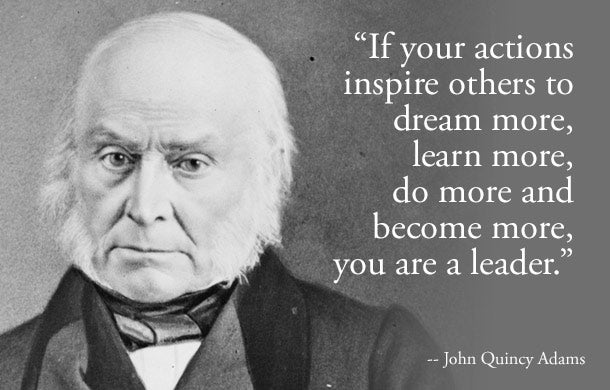
            Just like John Quincy Adams, he led but led with the overshadowing of his father.  Most of these leaders that I have mentioned led under someone’s shadow.  General Schwarzkopf was overshadowed by his father who was also a general, Franky Fontaine laid under the shadow of the Vaudevillians who came before him, Lee Debois was self-made as was Zig Ziglar, and Brian Tracy led by trial and error.  My grandfather lead by his upbringing…his father immigrated to the US in 1910 and brought old world thinking and my former boss, LTG Schoomaker was overshadowed by his brother General Peter Schoomaker who had been the Chairman of the Joint Chiefs.

            For the most part, these were big shoes to fill.  Giant men to follow.  A reputation to live up to.  I, too, know this feeling.  As I grew into a leadership role, I was always replacing a leader.

            Regardless, these leaders and I have always been faced with helping our follows find meaning for what they do.

            Dave and Wendy Ulrich ask the questions and provide the answer to engaging our followers: “So how can leaders more systematically help employees find meaning at work? We culled research from diverse fields of thought and identified seven drivers of meaning that leaders can leverage in the following ways:

  1. Help employees identify and creatively use the strengths, traits, and values (like integrity, leadership, love of learning, kindness, etc.) with which they most identify. Two useful tools for doing so are the Buckingham Strengthsfinder or the VIA Survey of Character Strengths.
  2. Match the purposes (insight, achievement, connection, or empowerment) that motivate employees to the jobs they do. For example, ask employees to spend 20 minutes writing about what work would look like if all their aspirations came true. Then help them build individual development plans to pursue those dreams.
  3. Foster friendships and key relationship-building skills — like making and receiving bids and apologizing effectively — to create high-performing, high-relating teams.
  4. Promote positive work environments through attention to characteristics like humility, selflessness, order, and openness. Survey employees on how well your organization exemplifies these crucial qualities; then develop a plan to improve where the results indicate the company falls short.
  5. Help people identify and work at the types of challenges that line up with their personal experience of engagement or flow.
  6. Build in time for both individual and corporate-level self-reflection to help people discover lessons from setbacks and develop the resilience to get in front of the pace of change.
  7. Encourage civility and delight from little things that personalize and civilize the world of work (e.g. time to chat, friendly competitions, pictures, and humor). Nokia, for instance, distributed thousands of plastic bracelets that employees wore to remind them not to complain for 21 days.
            To paraphrase Nietzsche, “He who has a ‘why’ to work can bear with almost any how.” To get the most from their employees, leaders should do all they can to make this “why” clear.
            We must give our followers the “why” and the motivation and not just the how.

Reference

Ulrich, D. and Ulrich, W. (June 2, 2010). Getting Beyond Engagement to Creating Meaning at Work. Retrieved on February 21, 2016 from https://hbr.org/2010/06/getting-beyond-engagement-to-c


Sunday, February 14, 2016

A511.5.3.RB_RemoteTransformationalLeadership_LouBeldotti


Remote Transformational Leadership


            It’s one thing to lead people from a distance.  It’s another to transform the organization while leading from afar.

            During my military career, I led face-to-face or at least from the same locality.  When I went to work for Northrop Grumman Corporation (NGC), I led from afar.  I had six followers that were dispersed across the United States.  I had never met a single one and had only communicated with them via telephone or email.  Although my tenure was short, it was indeed an experience that taught me a lot about remote transformational leadership.

            There was motivation attached to my performance at NGC.  I received monetary compensation in the form of an annual bonus.  The better the performance…performance was measured by client contract fulfilment and performance…the higher the bonus.

            In the scholarly article, Remote transformational leadership, scholars Kelloway, Barling, Kelley, Comtois and Gatien performed two studies to examine remote transformational leadership.  The abstract of their study reads, “We present two studies of remote transformational leadership.  In the first, 175 students read a vignette depicting either a laisse-faire, management by exception, contingent reward, or transformational leadership style communicated by electronic mail (e-mail).  Results showed that students could distinguish between the various leadership styles, and both interpersonal justice and supervision satisfaction were perceived to be higher when a transformational style was presented.  In the second study, 105 undergraduates completed individual and group problem solving tasks after reading an e-mail containing either an intellectually stimulating or charismatic message in a 2 x 2 design.  Participants properly identified the leadership style intended by the e-mail.  Motivation was higher, and both individual and group performance greater, in the leadership conditions.” (Kelloway, Barling, Kelley, Comtois and Gatien, 2002)

            While at NGC, I continuously performed self-analysis.  I shared my leadership style and vision with my subordinates.  The above mentioned scholars state, “More generally, the dynamics of transformational leadership involve followers having a strong personal identification with the leader, a shared vision of the future, and working collectively for the benefit of the group.  Yammarino and Dubinsky (1994) describe transformational leaders as heightening awareness and interests in groups, increasing employee confidence, and gradually moving the followers’ interests from the importance of their personal existence to the existence of the group.  Leaders achieve this by illustrating four main characteristics:

1.      idealized influence;
2.      inspirational motivation;
3.      individual consideration; and
4.      intellectual stimulation.
(Kelloway, Barling, Kelley, Comtois and Gatien, 2002)

            Upon my employment with NGC, I actually called a virtual group meeting (telecon) and collectively my six subordinates about myself, my expectations and how to be successful.  I explained that since I was their evaluator, I directly impacted their bonuses.  I asked each of them to tell me about themselves.  In the small world, I discovered that I had served with one of them previously on Active Duty.  They all agreed and shared my vision.  They were all on board.  Each was given my cell phone number, email and office number.  I told them that they could call, text or email me any time. 

            Not all people are cut out to work remotely.  It takes a unique individual to lead subordinates from afar.  Communication is key.  The follower must have access to the leader at any and all times.  This, in my opinion, makes it necessary for the remote leader to be very charismatic.  The transformational leader that lacks charisma is destined to fail thanks to his followers. 
            Barking orders via emails does nothing.  The researchers mentioned did, indeed, support their research goals.  Their thesis was proven.  They used kind email and barked orders.  When the study subjects received emails that were laissez-faire, or would receive a reward they identified the leader in one light while if the message transmitted with the flair of a transformational leader, they identified the leader in a different light. 
            This study has great value to the transformational leader, both remote and in person.  Remote leaders can lead if they are aware of how to communicate.

References

Kelloway, E. K., Barling, J., Kelly, E., Comtois, J., Gatien, B. (August 2002). Remote transformational leadership. Retrieved on February 13, 2016 from file:///C:/Users/ljbeldot/Desktop/Remote_transformational_leadership.pdf


Sunday, February 7, 2016

A511.4.3_LouBeldotti_LeadershipTraits

Leadership Traits:  A Blog


Alvin C. York may or may not be a name that you know.  He was portrayed in the Warner Brothers 1941 film, Sergeant York by Gary Cooper as Alvin York. (Warner Brothers, 1941)

Alvin had been a young renegade who lived on the Kentucky-Tennessee border in the late 1800s and early 1900s.  Alvin been drafted during World War I.  He began his life as a hell raiser and drunk moving into the twentieth century.  He was a drunk rabble-rouser who was far from religious.  His mother prayed for him continuously.  His mother’s pastor told Alvin that the Christian belief would someday come to him like a “bolt of lightning”. 

In the Warner Brother’s movie, he had actually been struck by lightning while riding his horse back from a Kentucky-Tennessee line bar.  This was the point that he heard the echoes of his mother and her pastor’s claims…he decided to become a Christian.  After being drafted, he stated that he was a conscientious objector.  His Company Commander, a Christian himself, offered him a 10-day furlough and when Alvin returned to Camp (Fort) Gordon, he believed that God wanted him to fight.  Alvin was sent to Europe and began his career as a combat Soldier in France.  

What is most spectacular is that Alvin York was ordered to charge machine guns and he and several others charged the German guns and York killed at least twenty Germans and took approximately 132 German Soldiers captive.  For his selfless bravery, Alvin York received the Medal of Honor (MOH) along with multiple U.S. and foreign awards.  This is what is said on his MOH citation:  “After his platoon suffered heavy casualties and 3 other noncommissioned officers had become casualties, Cpl. York assumed command.  Fearlessly leading seven men, he charged with great daring a machine gun nest which was pouring deadly and incessant fire upon his platoon.  In this heroic feat the machine gun nest was taken, together with 4 officers and 128 men and several guns.”  (Wikipedia, n.d.)

Alvin York embodied the finest of leadership traits and skills.  His traits came naturally but his skills were developed over time.

According to Dr. Gary Yukl’s text, Dr. Yukl states, “One of the earliest approaches to studying leadership was the trait approach, which involved a search for traits and skills that predict whether a person will attain positions of leadership and be effective in these positions.” (Yukl, 2013)
 
According to Dr. Yukl, there are eight specific traits related to leadership effectiveness.  Those eight traits are:
  • High energy level and stress tolerance
  • Internal locus of control orientation
  •  Emotional maturity
  • Personal integrity
  • Socialized power motivation
  •  Moderately high achievement orientation
  • Moderately high self-confidence
  • Moderately low need for affiliation

(Yukl, 2013)

Alvin York brought his natural traits to being a Soldier but spent time to develop his skills before his MOH moment.

I believe that I am in the same boat as Alvin York.  I learned how to turn my traits into skills.
I believe that I brought traits to my Army career but it took years to develop the skills of a true leader. 

I have always been a “people person”.  I also know that have a “Type-A” personality.  I have always been a forward thinker and very analytical.  These are some of the traits that I brought to my Army career.  However, I had no idea of how to harness these traits.  It wasn’t until several years and intense leadership training that I turned these traits into skills. 

I am very empathetic.  I believe that this is my strongest leadership trait.  I believe that you should feel or be able to feel what your subordinates are feeling.  If they are having a hard time, comfort them.  If they are having great experiences, praise them genuinely.  Know them personally and professionally.  I know their names.  I know the names of their spouses and children.  I know their needs.  I know their strengths and weaknesses.

As a school teacher, I know my Cadet’s strengths and weaknesses.  I am able to leverage my leadership traits and skills to best serve their needs.  I know how to reach them to help them grow. 
I believe that my employer sees this and knows that, because of my leadership, I am able to do exactly as I have said.  I believe that I improve the abilities of my students because of the leadership skills that I impart.  My students get better grades in their classes and standardized tests.  This is a direct reflection of how I teach them and the leadership that I impart.

Being a forward thinker, I know how to adapt and overcome.  Dr. Gary Yukl lays out six learning objective for contingency theories and adaptive leadership.  These objectives are:

  • Understand how aspects of the situation can enhance or diminish effects of leader behavior.
  • Understand key features of the early contingency theories of effective leadership.
  • Understand the benefits and limitations of contingency theories.
  • Understand the findings from empirical research on contingency theories.
  • Understand how to adapt leader behavior to the situation.
  • Understand how to manage disruptions and other crises.

(Yukl, 2013)

Alvin York was also a forward thinker and was very adaptive to his situations.  He overcame his desire to be a pacifist to go down in history as a great leader.  His command of contingency theory and adaptive leadership allowed him to do just that.

References

Warner Brothers. (September 27, 1941). Sergeant York. [IMDb].  Retrieved on February 7, 2016 from http://www.imdb.com/title/tt0034167/?ref_=ttco_co_tt

Wikipedia. (n.d.). Alvin C. York.  Retrieved on February 7, 2016 from https://en.wikipedia.org/wiki/Alvin_C._York

Yukl, G. A. (2013). Leadership in organizations (8th ed.). Boston, MA: Pearson.